Wednesday, June 27, 2012

Chapter Book 9


A.    Author: Pamela Porter
B.     Title: Sky
C.     Illustrator:Mary Jane Gerber
D.    Readability: 3
E.     Genre: Historical
F.      Subgenre: Faction
G.    Theme: Native Americans, Discrimination, Love
H.    Primary and secondary characters: A little Girl, Gramma, Paw Paw
I.       Award(s) date of publication:
J.       Publishing company: Groundwood Book
K.    ISBN number: 0-88899-607-1
L.     Brief summary:  A Native American girl living on the Blackfoot Reservation, birthing lambs with her Paw Paw. As winter melted into spring the stream that ran behind their house and barn, turned into a raging river. Forcing the family to barely make it out to the city’s white school. They were rushed into a small classroom, when the whites received a cot, and free food. The natives were treated as aliens, being made to pay for food, silverware, it was impossible, they lost almost everything. As the second day begun, their Uncle found them , paying him 15 dollars, the family was allowed to stay. One day she returned to where their home used to be, to find a poor little filly trapped in barbwire covered in mud and cold. They couldn’t leave her, so they brought her back to her uncles house, and nursed the tiny girl back to health. As school was about to resume, the 7 Native American’s were shuffled to the all-white school. She and her 7 friends went days being bullied, when she finally had enough when two students dropped  a cheat sheet under her desk, while taking a test. She was kicked out of school for the day, but she vowed never to return. By this time her family had bought the house that was behind the grocery store, the owner needed to sell it in order to expand and Paw Paw and Gramma needed a home. The little pony Sky had grown up and was still living at her uncles house. Her uncle and gramma built a lean to for chickens and her horse. Sky was moved home. A year later her Paw Paw died, and she was determined to train her horse, and continue school. She brought Sky over to her uncles farm to use his corral. After several tries, Sky learned she was to be ridden and waited to learn. She and Sky rode back to the house, her gramma got up and cried, saying she was the only reason her paw paw lived another year. That night she and sky went out to the field, and  reflected on her culture and how her paw paw, mother, father, and culture will be proud of her.
M.   Description of how you would use the book with students: I will use this book to relate to the native American culture. We can discuss how she was treated in the wake of disaster and how her life changed because of it. We can have a connect to writing, how did our life change after a major event. 

Picture Book 19


A.    Author: Michael Shoulders
B.     Title: V is for Volunteer
C.     Illustrator: Bruce Langton
D.    Readability: 3
E.     Genre: Informational
F.      Subgenre: Non-Fiction
G.    Theme: Alphabet, Tennessee
H.    Primary and secondary characters:
I.       Award(s) date of publication:
J.       Publishing company:Thomson Gale
K.    ISBN number: 978-1-58536-033-8
L.     Brief summary:  V for Volunteer, educates the reader on the state of Tennessee. It walks us through the best aspects of Tennessee, Nashville, Jubilee singers, and much more. It also uses the alphabet to help us build our vocabulary. Lastly, at the end of the book, it has a review section, where we can test our knowledge of the state that we learned.  
M.   Description of how you would use the book with students: I would use this when teaching the 50 states of the US, and when teaching about the state of Tennessee’s history, we live here we should know the critical information . We can also make our own alphabet based on the state of TN. We can get creative and use our town that we live in to make our own book.

Picture Book 18


A.    Author: Michael Shoulders
B.     Title: M is for Magnolia  
C.     Illustrator: Rick Anderson
D.    Readability: 3.3 (Scholastic Wizard)
E.     Genre: Informational
F.      Subgenre: Non-Fiction
G.    Theme: Mississippi, Alphabet
H.    Primary and secondary characters:
I.       Award(s) date of publication:
J.       Publishing company:Thomson Gale
K.    ISBN number: 1-58536-129-1
L.     Brief summary:  M is for Magnolia, is an alphabet book, based on the current facts and history of the state of Mississippi. Each letter represents something very important the building and imprint of the state of Mississippi. Along with the letter, the sentences almost form a poem.  Also each page goes into details as to how each letter and word impacts the state.
M.   Description of how you would use the book with students: I would use this when teaching the 50 states of the US. It reinforces the alphabet and helps student come up with creative and informational facts about Mississippi!

Tuesday, June 26, 2012

Picture Book 17

A.    Author: Rebecca L. Johnson
B.     Title: Journey into the Deep: Discovering New Ocean Creatures
C.     Illustrations:
D.    Readability: 5
E.      Genre: Informational
F.      Subgenre:   Fiction
G.    Theme: Deep Sea Animals,
H.    Primary and secondary characters:
I.       Award(s) date of publication:  Orbis Pictus Award
J.       Publishing company: Millbrook Press
K.    ISBN number:0-8037-2860-3978-0-7613-4148
L.     Brief summary: The book starts with the journey that would be one of the most important deep sea dives in many years past and to come. Scientists looked for new species and studied species that already were classified. The scientists first started in Maine, on the coast. Looking for any animals that live only the coast, once the animals are found they are put in alcohol to preserve them. Our next stop is Australia, in the coral reefs. The scientists search all day, then they come back to search in the dark. Then they move to open water, collecting sea butterflies, and other deep sea creatures. The remotely operated  underwater vehicle was deployed, looking at screens everyone waits for new discoveries. You see coral the size of trees and zooplankton floating past your window.The further down the water is full of methane and smells like rotten eggs. As the bottom gets closer, tube worms look like bushes. Moving to the North Pole, the ROV heads to the midnight zone. Jellyfish emerge from the deep dark bottom. As you return to the surface, a trawl is released behind the boat, gathering samples of the ground and life forms that get caught in the net. The crew then moves to New Zealand’s water mountains. A Venous fly trap is found at the mountains, along with a squat lobster. Lastly, off to the deepest part of the ocean, a camera free falls from a stable strong stand, at 25,000 feet fish bhave been officially seen. Also a new comb jelly fish is discovered. The main objective in this book is to preserve the ocean, not destroy it.        
M.   Description of how you would use the book with students: I would use this book when discussing the deepest parts of the ocean. No one really is taught about the depths that we cannot see and this book allows us to teach facts that could help students plan their future of marine biology.  

Monday, June 25, 2012

Picture Book 16


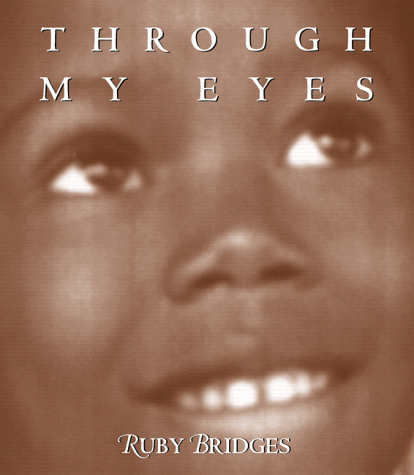
A.    Author: Ruby Bridges
B.     Title: Through My Eyes
C.     Illustrations:
D.    Readability: 5.6
E.      Genre: Autobiographical
F.      Subgenre:   History
G.    Theme: Civil Rights Movement, African American History, Tolerance, Courage, School
H.    Primary and secondary characters: Ruby
I.       Award(s) date of publication:  Newbery
J.       Publishing company: Scholastic
K.    ISBN number:0-590-18923-9
L.     Brief summary: 7lb baby girl, born in Mississippi in 1954. Her grandparents, were sharecroppers, a vegetable and dairy farm.  Ruby would spend her summers visiting her grandparents with her cousins. Soon her family moved to New Orleans, living in a two bedroom house, her and seven other siblings piled in one of the rooms. She started 1st grade, but her family did not have education, they spent too much time working to keep the family afloat. When Ruby started school they attended Johnson Lockett, it was an all-black school.  Soon New Orleans started to being the integration of blacks into white schools. In order to be admitted to the new schools, they started testing children. The test was very hard, but Ruby was one of the very few who passed it. Her parents soon fought over the idea of experiencing segregation verses better education. In September, Ruby retuned to Johnson Locket because government slowed the process of non-segregated schools. On November 14th, Ruby started at her new school. There was only 4 African American students. She was escorted to school by the U.S. Federal Marshals. Ruby doesn’t remember seeing any faces, but she was only 5 years old.  Ruby remembers seeing parents, white parents, rush into the principal’s up in arms about the new colored students, they would point and pull their children from class. As she went home, a person held a black doll in a coffin, frightening her the most. Soon her friends and her jumped rope to the words “two, four, six, eight we don’t want to integrate.” Those words had no meaning to the little girls, they just were fun to jump to. The first real day in the classroom Ruby was the only child, with two rows of desks she would not be allowed outside or to eat lunch with the cafeteria. The third day, her mother could no longer go to school with Ruby.  John Steinbeck, was driving through New Orleans, he observed the horrific things and wrote in his book, Travels with Charley,  about Ruby and her horrid experience as she entered the school. Not only did riots break out in front of the school, but all across the city. Bricks spewed at passing cars, flaming bottles of gas flew across cars. The KKK tormented the blacks and their homes. Because of the integration the grocery store no longer want the families money, their grandparents no longer wanted to come for Thanksgiving because their lives would be endangered. Money was sent to help support Ruby’s family, as for presents and toys as well! Ruby’s name was on all the packages but her mother said, she must share, though Ruby didn’t agree. Barbra Henry, loving and caring had only one student, Ruby. Ruby even started to talk exactly like Mrs. Henry, since she was northern, she had a different accent. Ruby began to quit eating, thinking she could become like every other student. Ruby began to understand that her life would be about bettering herself, that she will BE someone. Towards the end of the year, white students began to come back. This is when Ruby understood why people were acting in the stand-off manner. This is when she realized, she was different, because she was black. As second grade started, there were no escorts, and she was no longer the only student, she was one of twenty!  She was left alone, no one helping her, she found out Mrs. Henry  had returned to Boston during the summer.  Since the 2nd grade Ruby graduated from an integrated high school. Her parents had separated. She says the reason she got through her tough life, was her discipline, and her being the oldest and required for the most responsibility.  Ruby had the choice of college, but those doors didn’t open so easily. She was the first African American  to work for American Express, a travel agency.  Ruby’s brother was shot, and she realized  she must help. She returned to Frantz School, she became a parent liaison . She wanted to turn inner city schools around, the kids deserve it. After the book The Story of Ruby Brudges was published, she was reunited with Mrs. Henry, on the Oprah Winfrey Show.
M.   Description of how you would use the book with students: Ruby’s story  was moving. She WAS that little girl. I would ask the students to read and reflect. The emotions in the book are powerful I want to get how these students felt when reading it. I will have a choice, photographs of feelings or writing.


Picture Book 15


A.    Author: Bettye Stroud
B.     Title: The Patchwork Path: A Quilt Map to Freedom
C.     Illustrations: Erin Susanne Bennette
D.    Readability: 3.7
E.      Genre: Historical
F.      Subgenre:   Fiction
G.    Theme: Cultural Diversity
H.    Primary and secondary characters: Hannah
I.       Award(s) date of publication:  
J.       Publishing company: Candlewick Press
K.    ISBN number:0-7636-2423-3
L.     Brief summary: Hannah, a Georgia plantation slave, turned 10 and her mother taught her the trade of sewing patchwork quilts. Each square means something special, like secrets. Mama passed away shortly after Hannah got the trick of stitching down. The quilts made stories, stories of the bear paws trail and how to get to Canada, away from slavery. Hannah’s father told her to hang the monkey wrench quilt out, telling the other slaves that they were about to run! As they started to run, Hannah thinks she hears dogs barking. The finally come to a church on the edge of town. Hannah prayed she would be reborn as a free girl in Canada. By night Hannah and her father ran through a tunnel made by pirates. They would go hungry, or if they could catch fish her father would cook that for dinner, sometimes Hannah would get honey and bees would sting her.  As summer began Hannah and her father found a safe house to hide in, they gave them clean clothes and food. The next day a Quaker, hide them in his wagon, hidden under straw and blankets. The Quaker brought them all the way to Lake Erie. They drew a log cabin in the sand, someone will notice and bring a boat. A free black man saw them, gave them clothes that looked like Sunday’s best. As night fell, Hannah’s father rang a bell, they soon were on a riverboat, Hannah then saw Canada. She felt reborn. Hannah’s first winter was spent making a new quilt, it was made from old slave clothes and new fabric. It was a code, but a square was left empty. Hannah missed her sister and waited for her to join them.
M.   Description of how you would use the book with students: I would use this book  to talk about how creative African American’s had to be creative, to escape. I would ask my students to make a quilt about their life and display them in the classroom while we study this subject.

Picture Book 14


A.    Author: Carol Boston Weatherford
B.     Title: Freedom on the Menu: The Greensboro Sit-In
C.     Illustrations: Jerome Lagarrigue
D.    Readability: 3.2
E.      Genre: Historical
F.      Subgenre:   Fiction
G.    Theme: African American History, Civil Rights Movement, Black History Month
H.    Primary and secondary characters: Daughter and Mother
I.       Award(s) date of publication:  
J.       Publishing company: Dial Books for Young Readers
K.    ISBN number:0-8037-2860-3
L.     Brief summary: A mother and her daughter, step into the snack bar. They grab a soda. But they do not sit, the mother explains, we are not welcome here at the tables. But there is no signs. As she thinks back, there are signs everywhere, white only, black only. When they come home that night, her father tells them that Dr. King will be coming to the city to help make things better for colored folk. Dr. King talked at the college chapel and the crowds said Amen and clapped often!  Soon after her brother and sister joined the NAACP. Then one day mother and daughter went to the snack bar after shopping to find 4 college boys sitting at the counter. They sat there for 4 hours. Soon sit ins began to take over the news. Her brother and sister soon joined the sit ins. The sister was put in jail during a sit in, when her parents came to bail, she refused to leave. Then one day as the mother, father and daughter were headed to town, someone screamed, “They’re serving them!”  All people came to see, the African American women eating and egg salad in the Snack Bar, at the table. That next day, they brother and sister took her to the Snack bar and she ordered her banana spilt.     
M.   Description of how you would use the book with students: This book would be best used to help students understand the start of the sit ins and the racial issues with the 1950’s. We can read this book and connect it to writing, the students can write how they felt about the racial issues.